
From Sounds to Stories: The Montessori Journey to Reading and Writing
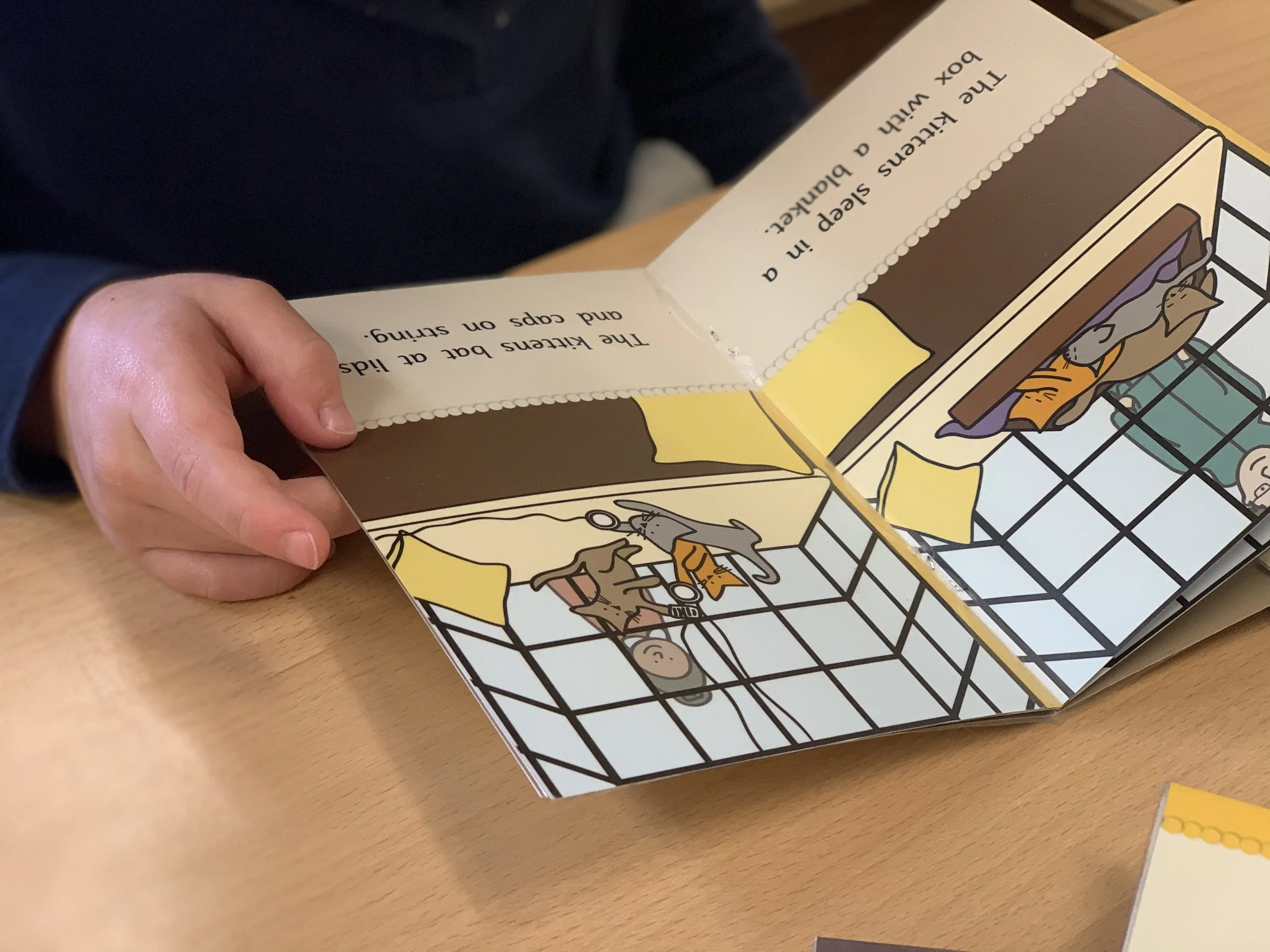
Understanding literacy development across the three-year Primary cycle
How does a child learn to read in a Montessori classroom?
For many parents, learning to read is one of the most anticipated milestones of early childhood. We celebrate the moment a child recognizes their first word, sounds out a sentence, or proudly reads a book independently.
But in a Montessori environment, the journey toward literacy begins long before a child opens their first book. It begins with conversation, storytelling, movement, curiosity, and a deepening awareness of the sounds that make up our language.
At Mountain Shadows International Montessori School (MSIMS), our AMI Montessori Primary environments serve children ages three to six within a thoughtfully designed, three-year developmental cycle. Throughout these years, children build the foundations of literacy through carefully sequenced materials, individualized lessons, and opportunities to explore language at their own pace.
What may appear to be simple work with objects, letters, or cards is actually part of a remarkable progression toward reading, writing, comprehension, and self-expression.
The First Year: Building the Foundations of Language (Approximately Ages 3–4)
Before children can read words, they must become aware that spoken language is made up of individual sounds.
Much of the earliest literacy work in a Montessori Primary classroom happens without a pencil, paper, or even a written letter.
Children participate in rich conversations, listen to stories, learn poetry, sing songs, and explore precise vocabulary through hands-on experiences. They name objects, classify pictures, describe what they observe, and learn new words connected to the natural world, geography, science, and everyday life.
These experiences expand vocabulary, strengthen listening skills, and develop the ability to express increasingly complex thoughts.
Hearing the Sounds in Words
One of the most important early literacy experiences in an AMI Primary environment is the Sound Game, sometimes called "I Spy."
A Guide might say, "I spy something that begins with /m/," inviting children to listen for the beginning sound of a familiar object.
As their auditory discrimination develops, children begin identifying ending sounds and eventually sounds within words.
This is phonemic awareness: the understanding that spoken words are made up of individual sounds. It is a foundational skill for learning to read and spell.
Meeting the Sandpaper Letters
Once children demonstrate readiness, they are introduced to Sandpaper Letters.
Each letter is presented through multiple senses. The child sees the symbol, traces its shape with their fingers, and hears the sound it represents.
Rather than beginning with the names of letters, Montessori instruction emphasizes the relationship between written symbols and the sounds of spoken language.
This multisensory experience helps children connect what they hear, see, and feel, preparing them for both writing and reading.
At the same time, children engage in Practical Life and Sensorial activities that strengthen coordination, concentration, visual discrimination, and control of movement. These seemingly unrelated experiences contribute to the physical and cognitive foundations needed for written language.
What parents may notice: Their child begins identifying sounds in everyday words, recognizing familiar letter symbols, using increasingly precise vocabulary, and showing greater interest in language.
These are meaningful literacy milestones, even before conventional reading begins.
The Second Year: Discovering the Power of Written Language (Approximately Ages 4–5)
As children become more confident identifying sounds and associating them with symbols, a remarkable shift begins.
They discover that the sounds they hear in spoken words can be represented by letters, and that those letters can be arranged to communicate their own ideas.
Why Writing Often Comes Before Reading
One of the distinctive features of Montessori literacy education is that children frequently begin composing words before they can independently read them.
This may seem surprising, but writing and reading involve different processes.
When a child wants to write a word, they already know what they want to say. Their task is to listen for the sounds and identify the corresponding symbols.
Reading requires the reverse process: seeing unfamiliar symbols, translating them into sounds, blending those sounds, and discovering the meaning of the word.
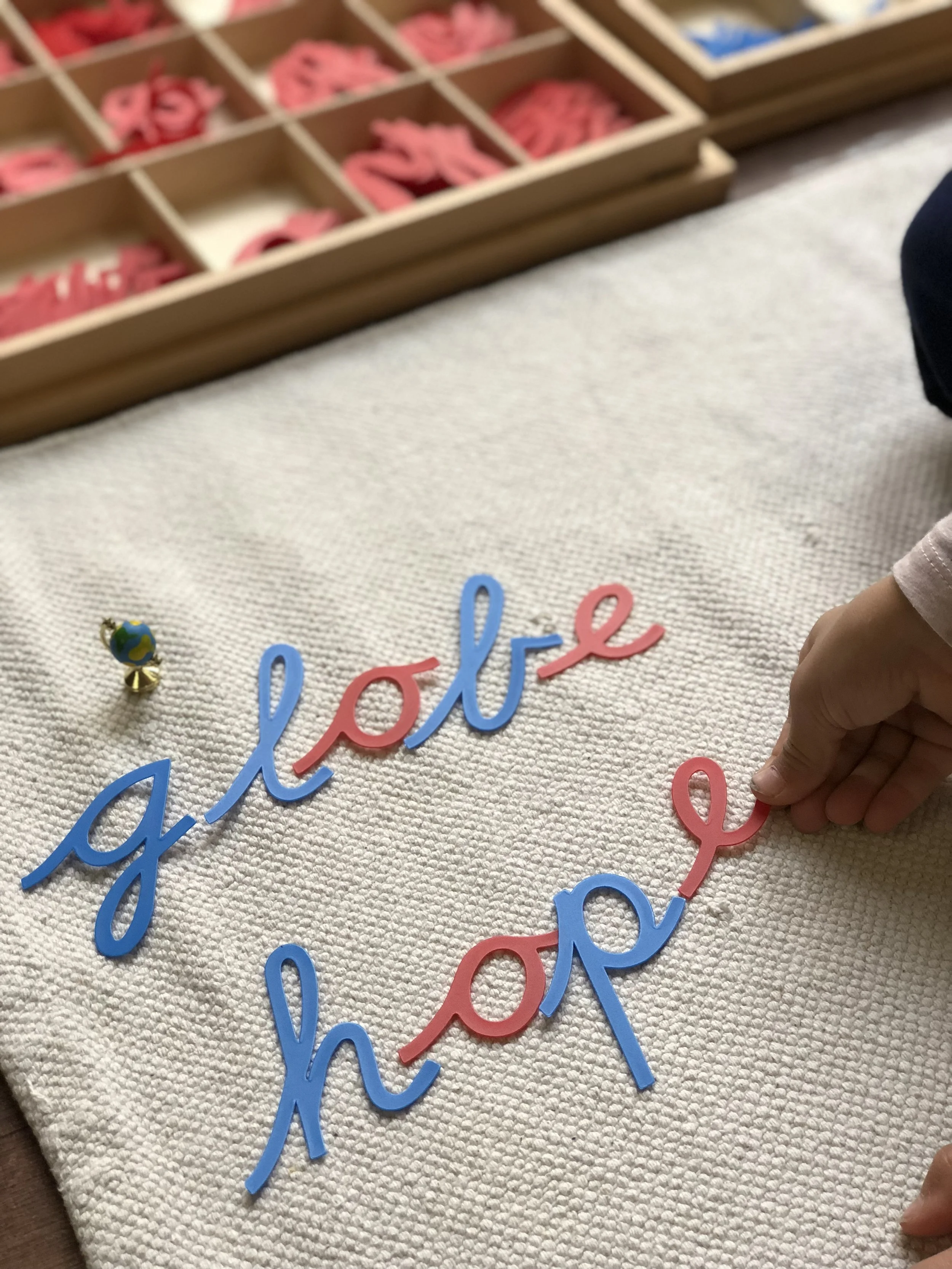
The Montessori Moveable Alphabet allows children to explore written expression before their hands are ready for extensive handwriting.
Using individual wooden letters, a child might construct the word "cat" by listening for each sound and selecting the matching symbols.
Over time, children begin composing longer words, phrases, and sentences.
At this stage, phonetic or invented spelling is a natural part of development. A child who writes "I luv mi dog" is demonstrating an important understanding of how sounds connect to written language.
The emphasis is on helping children discover that their thoughts can be expressed through written symbols.
Preparing the Hand for Writing
While children explore composition with the Moveable Alphabet, they continue developing the physical skills needed for handwriting.
Materials such as the Metal Insets support pencil control, coordination, precision, and the movements required to form letters.
Sandpaper Letters also reinforce the muscular memory associated with letter formation.
Eventually, these experiences come together as children begin writing letters, words, and sentences by hand.
The Emergence of Reading
As children gain confidence with sound-symbol relationships, they begin decoding simple phonetic words.
Montessori reading materials progress systematically, beginning with words that follow familiar phonetic patterns and gradually introducing more complex sound combinations, phonograms, and spelling patterns.
Children work with objects, labels, cards, and carefully sequenced reading activities that allow them to discover meaning through written language.
For some children, this transition happens gradually. Others experience what Dr. Montessori described as an explosion into reading, when previously developed skills suddenly come together and reading becomes increasingly independent.
What parents may notice: Their child begins sounding out words, constructing messages with letters, recognizing familiar written words, experimenting with spelling, or reading simple phrases.
Children may be developing these skills at different times, and the Montessori Guide carefully observes each child's readiness before introducing the next lesson.
The Third Year: From Decoding to Understanding (Approximately Ages 5–6)
The third year of the Montessori Primary cycle, traditionally the kindergarten year, is especially significant.
During the first two years, children have been building a foundation through oral language, phonemic awareness, sound-symbol relationships, composition, and early reading experiences.
In the third year, many of these skills begin to come together in increasingly sophisticated ways.
Children who once worked to identify individual sounds may now read sentences, write stories, explore grammar, and use written language to pursue their own interests.
Reading for Meaning
Learning to read is about far more than sounding out words.
As children's decoding skills become more automatic, they can devote greater attention to understanding what they read.
Montessori reading experiences increasingly emphasize vocabulary, meaning, comprehension, and the ability to interpret written information.
A child might read labels associated with scientific materials, follow written instructions, explore a book about animals, or read information connected to geography and botany.
Reading becomes a tool for discovery rather than an isolated academic exercise.
Discovering How Language Works: The Function of Words
One of the most fascinating aspects of the AMI Montessori Primary language curriculum is that children begin exploring grammar through concrete experiences long before they are expected to memorize grammatical definitions.
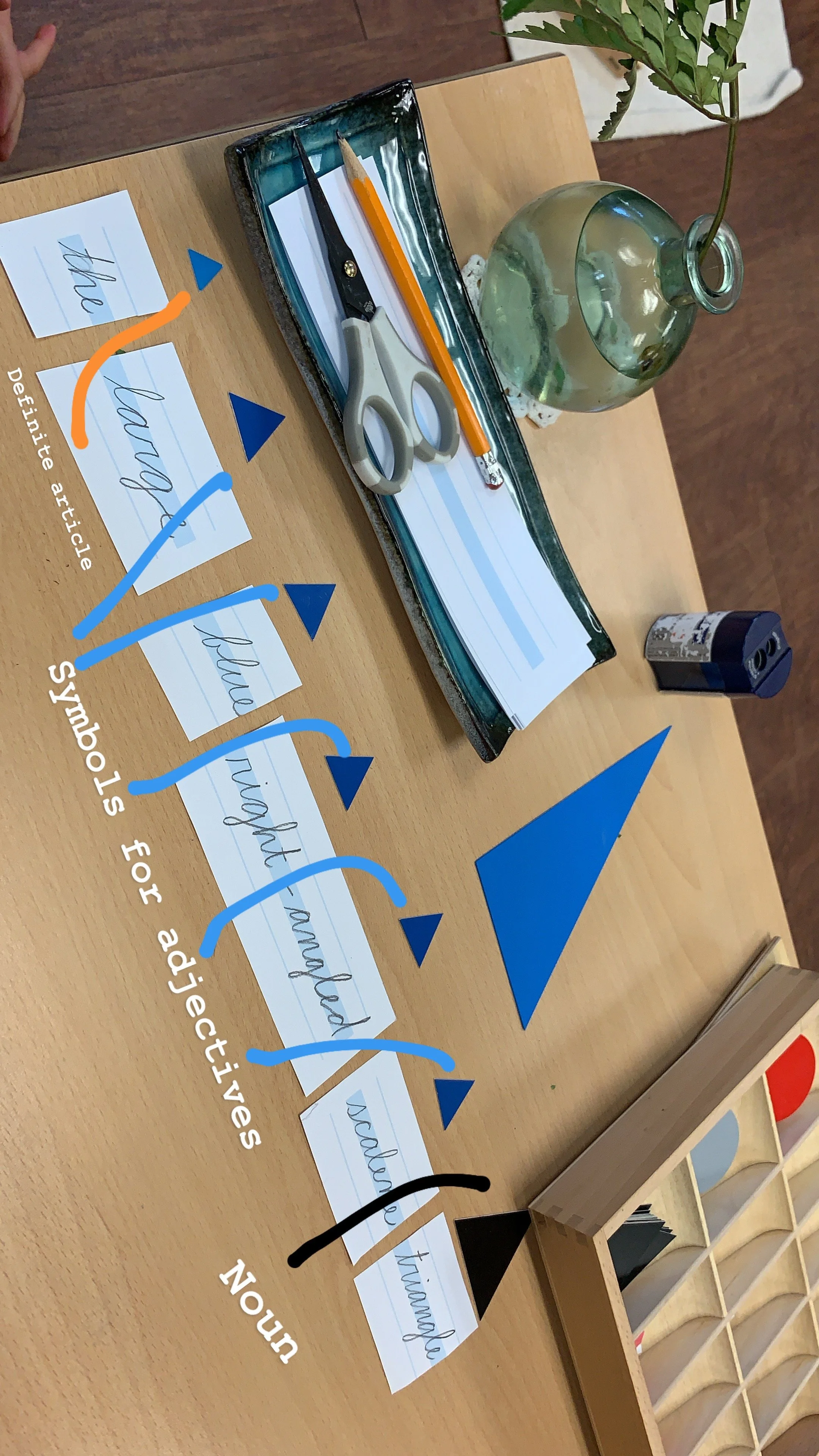
This work, known as the Function of Words, invites children to discover that different words have different jobs within a sentence.
Rather than beginning with a worksheet identifying nouns, verbs, or adjectives, the Guide introduces language through objects, movement, and carefully designed activities that allow children to experience the meaning of words firsthand.
Imagine a Guide asking a child to bring a pencil.
Now imagine the instruction changes: "Bring me the long, red pencil."
The child must consider not only the object being named but also the words that describe it.
Or perhaps the Guide asks the child to place a small object under a chair, beside a basket, or between two blocks. The child physically experiences how prepositions describe relationships.
These experiences gradually introduce children to the functions of different parts of speech:
Nouns name people, places, animals, and things. Children have already spent years developing this understanding through vocabulary and classification activities.
Articles such as a, an, and the help children distinguish between general and specific references.
Adjectives describe qualities such as color, size, texture, and shape, allowing children to communicate with greater precision.
Verbs bring language into action. Children might read a command to jump, whisper, carry, or stretch and then perform the action themselves.
Adverbs describe how actions happen. A child discovers the difference between walking slowly and walking quickly.
Prepositions express relationships between objects, such as placing something behind, under, or beside another object.
Conjunctions connect words and ideas, helping children understand how language brings separate elements together.
Through these experiences, children discover that changing even one word can change the meaning of an entire sentence.
The beauty of this approach is that grammar becomes something children can see, touch, act out, and understand.
As their reading skills develop, children begin exploring increasingly complex written commands, sentences, and language activities. They develop an awareness of word order, descriptive language, sentence structure, and the relationships between words.
These concrete discoveries lay the foundation for the more abstract grammar studies and sentence analysis that continue in the Montessori Elementary environment.
Rather than simply memorizing rules, children develop an understanding of how language works and how they can use it to communicate their ideas with greater clarity and intention.
Writing With Purpose
As children develop confidence in their writing abilities, they begin using written language for increasingly meaningful purposes.
They may write stories, compose messages, label their work, create lists, or record observations.
Writing becomes more than a mechanical skill. It becomes a way to communicate ideas, share experiences, and express imagination.
The third year also provides opportunities for children to revisit familiar materials with greater independence and complexity, strengthening skills that were introduced earlier in the cycle.
What parents may notice: Their child reads with increasing independence, writes longer messages or stories, asks questions about words, demonstrates growing comprehension, and begins using reading and writing naturally throughout the day.
Beyond Decoding: The Montessori Concept of Total Reading
Maria Montessori recognized that learning to pronounce written words and truly understanding what we read are not the same thing.
This distinction is central to the Montessori concept of total reading.
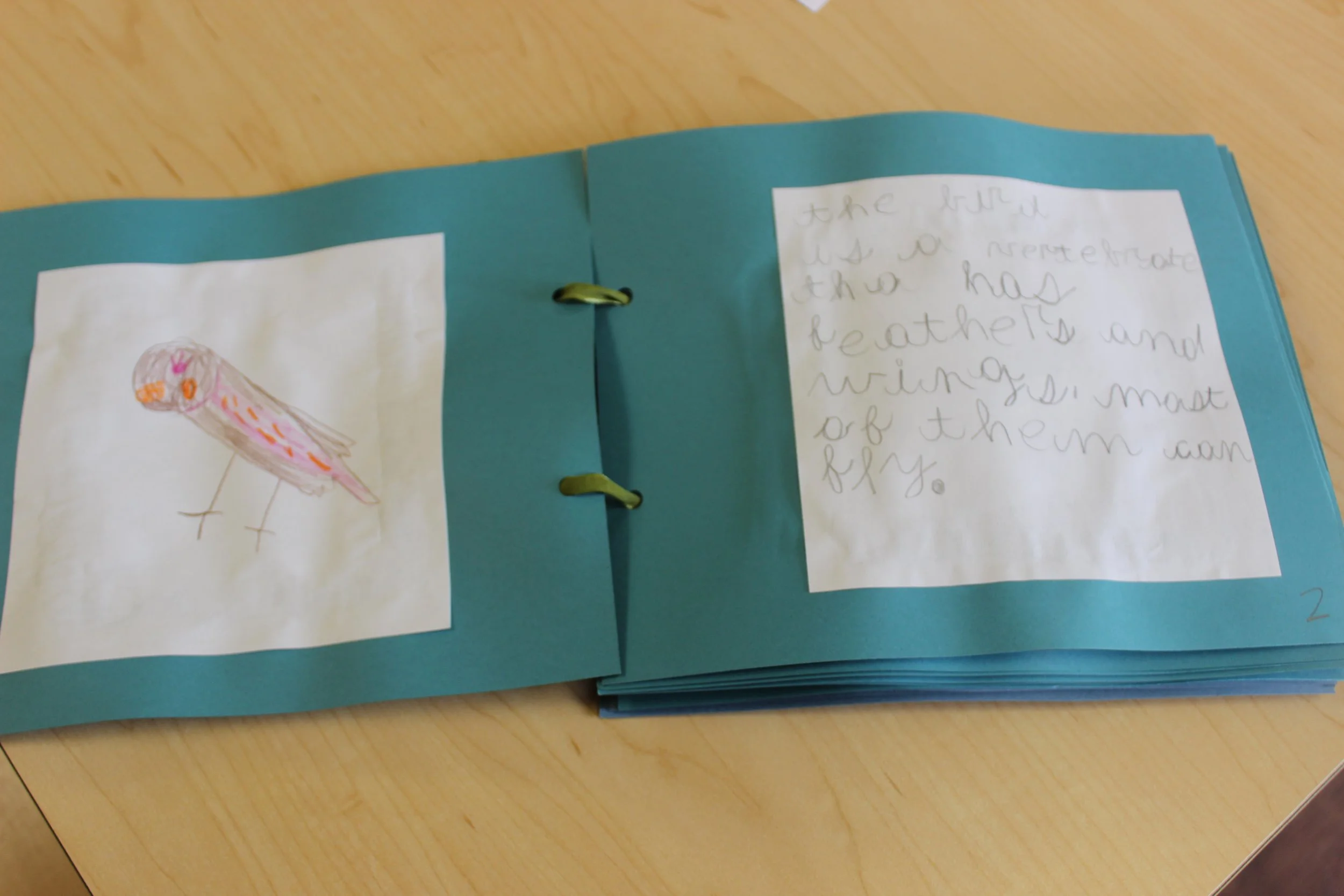
Total reading goes beyond the mechanical ability to decode words. It involves understanding the meaning, intention, expression, and ideas communicated through written language.
The foundations of total reading begin in Primary and continue developing throughout Elementary and beyond.
In the Primary environment, children encounter reading experiences that require them to actively interpret what they have read.
They may read a written command and carry it out, match a descriptive phrase to an object, interpret instructions, or explore how a change in wording affects meaning.
Through these experiences, reading becomes an active process of thinking, interpreting, and understanding.
A child who reads the sentence "The bird flew away" may initially focus on recognizing the words. As comprehension develops, that same child begins imagining the bird's movement, connecting the sentence to their own observations, and perhaps wondering where the bird went.
The child is no longer simply decoding. They are making meaning.
When Reading Becomes a Tool for Discovery
Perhaps the most meaningful outcome of Montessori literacy education is the moment a child realizes that reading provides access to information they can discover independently.
A child fascinated by insects can begin looking through books to learn about the life cycle of a butterfly.
A child curious about the planets can explore written information about the solar system.
A child interested in cooking can follow a recipe. Another may discover the names of birds visiting the school garden or seek answers to questions about animals, geography, or the natural world.
Reading becomes more than an academic skill.
It becomes a means of satisfying curiosity.
This is particularly important as children prepare for Montessori Elementary, where independent research, inquiry, and the pursuit of knowledge become increasingly central to their learning.
We want children to turn to books not simply because they have been asked to read, but because they genuinely want to learn something.
The goal is not simply to develop children who can read, but children who love to read, understand what they read, and recognize reading as a powerful tool for exploring the world.
Why the Three-Year Montessori Cycle Matters
One of the greatest strengths of the Montessori Primary environment is the continuity of the three-year cycle.
Literacy development is not divided into three disconnected academic years. Instead, lessons build upon one another within a consistent environment where children have the time and opportunity to practice, revisit, and deepen their understanding.
A child who begins Primary at age three may spend their first year developing vocabulary and sound awareness, their second year exploring written expression and decoding, and their third year applying these skills with increasing independence.
These are not rigid timelines. They are interconnected developmental experiences that unfold according to each child's readiness.
The mixed-age environment also offers something especially valuable.
Younger children observe older classmates reading books, writing stories, and using language materials independently. These experiences create natural curiosity and motivation.
Older children, in turn, gain confidence as they recognize their own growth, revisit familiar work, and serve as models within the classroom community.
The kindergarten year is therefore not simply the final year of preschool. It is an important period of consolidation, leadership, independence, and academic growth within the Montessori Primary experience.
What About Reading Readiness and Individual Differences?
Every child arrives in the Primary environment with a unique developmental history.
Some children demonstrate early interest in written symbols. Others are especially drawn to storytelling, conversation, movement, or hands-on exploration before showing a strong interest in reading.
Montessori education recognizes that readiness is individual, but individualized learning does not mean leaving literacy development to chance.
Our AMI-trained Guides carefully observe each child, introduce lessons in a deliberate sequence, monitor progress, and provide opportunities for repetition and mastery.
When a child needs additional support, our responsibility is to recognize those needs and respond thoughtfully rather than simply waiting for development to occur.
This balance of developmental respect and intentional instruction is central to Montessori education.
How Families Can Support Literacy at Home
Parents often ask what they can do to support their child's emerging reading and writing skills.
The most meaningful experiences are frequently the simplest:
Read together every day. Enjoy beautiful picture books, nonfiction, poetry, and stories that invite conversation.
Talk with your child. Use rich vocabulary, ask open-ended questions, and allow time for thoughtful responses.
Play with sounds. Notice rhyming words, beginning sounds, and the sounds you hear in familiar names.
Encourage meaningful writing. Invite your child to help make a grocery list, write a note, or label a drawing.
Model a love of reading. Let your child see you reading books, recipes, instructions, and other written materials for enjoyment and purpose.
Follow your child's interests. A child fascinated by insects may be especially motivated to explore books about butterflies or beetles.
There is no need to rush children through reading levels or introduce formal worksheets to accelerate their progress.
If you are interested in practicing specific letter sounds or reading skills at home, your child's Lead Guide can help identify activities that complement their current classroom work.
A Journey Worth Trusting
When we observe a three-year-old carefully tracing a Sandpaper Letter, a four-year-old composing a word with the Moveable Alphabet, or a five-year-old reading a story independently, we are witnessing different moments along the same developmental journey.
Each experience builds upon the one before it.
The beauty of Montessori literacy education is not simply that children learn to read and write. It is that they discover language as a powerful tool for understanding the world, communicating their ideas, and connecting with others.
Our hope is that the child who once delighted in identifying the first sound in a word will one day reach for a book because they have a question they want to answer, a story they want to experience, or something new they want to discover.
At Mountain Shadows International Montessori School, we believe that this foundation, developed thoughtfully across the three-year Primary cycle, supports far more than early literacy.
It nurtures curiosity, confidence, independence, and a lifelong love of learning.
Interested in seeing Montessori literacy development in action? We invite our families to connect with their child's Lead Guide, participate in classroom observations, and learn more about the extraordinary work unfolding in our Primary environments every day.